
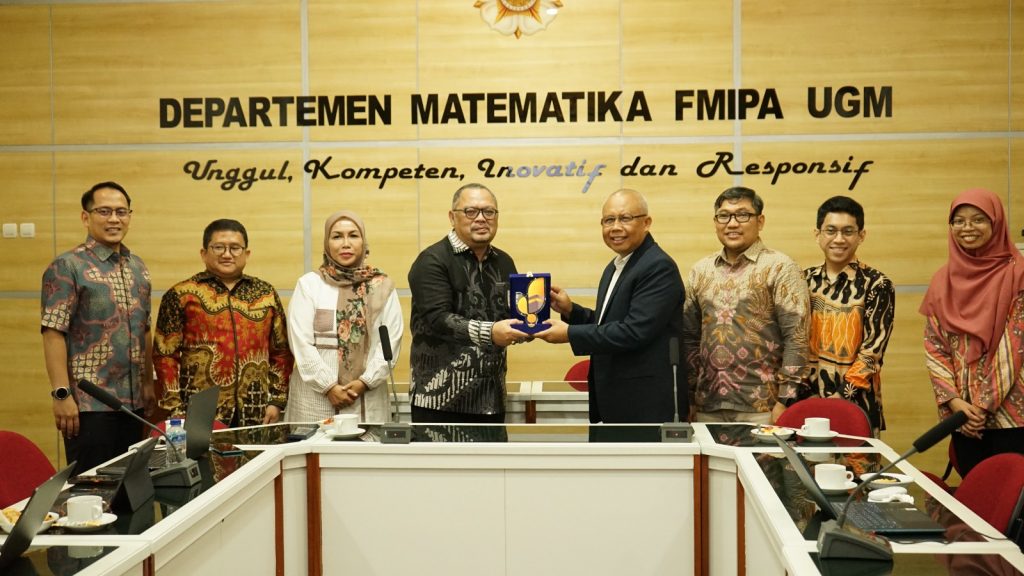
 Yogyakarta, August 5, 2025 — The Faculty of Mathematics and Natural Sciences (FMIPA) at Universitas Gadjah Mada (UGM), in collaboration with the Hajj Financial Management Agency (BPKH), held a Focus Group Discussion (FGD) to present the results of a study titled Future Asset, Future Liabilities, and Financial Modeling. This study aims to support the long-term sustainability of Indonesia’s Hajj fund until 2055. The event took place at the 3rd floor meeting room of the Department of Mathematics, FMIPA UGM, and was attended by BPKH leaders and the UGM research team.
The event was officially opened by the Dean of FMIPA UGM, Prof. Dr. Eng. Kuwat Triyana, M.Si., who emphasized the important role of academics in supporting public policy through research, especially in managing Hajj finances in the long term. This was followed by a speech from Prof. Dr. H. M. Arief Mufraini, Lc., M.Si., a member of BPKH’s Executive Board for Direct Investments, Planning, Research, and Development. He appreciated the close and productive collaboration between BPKH and the FMIPA UGM research team. Prof. Arief also introduced the lead researcher, Dr. Danang Teguh Qoyyimi, M.Act.Sc., Ph.D., ASAI, a lecturer at the Department of Mathematics, who led this study.
As a symbol of partnership, the event continued with a token of appreciation exchange and the signing of the Handover Report (BAST), marking the official submission of the study’s interim report from the research team to BPKH.
Several key BPKH officials were present at the event, including Dr. Hadiyati Munawaroh (Deputy of Planning, Research, and Development), Anas, S.T., M.M. (Deputy of Direct Investment), Dr. Agung Sri Hendarsa (Head of Research and Development Division), and Mohammad Taufiq Rinaldi (Head of Strategic Planning Division). In her session, Dr. Hadiyati highlighted the importance of long-term investment planning to anticipate future Hajj financial obligations, and the need to fulfill administrative aspects in such partnerships.
The main session featured a presentation by Dr. Danang Teguh Qoyyimi, who shared the key findings of the study. These included survey results on Ability to Pay (ATP) and Willingness to Pay (WTP) from 2025 prospective Hajj pilgrims, projections of future assets and liabilities, and the development of a financial model to test the sustainability of the Hajj fund under different investment and cost scenarios up to 2055.
Following the presentation, the discussion session continued in a focused and constructive manner. Participants from BPKH and FMIPA UGM engaged in in-depth dialogue about future scenarios of Hajj fund management. This discussion served as a strategic forum to align technical and policy perspectives, aiming to formulate practical steps for managing the Hajj fund in a way that is resilient to economic changes and ensures continued services for pilgrims. The insights and analyses shared during this session are expected to contribute to BPKH’s future strategic planning—plans that are data-driven, long-term oriented, and based on good governance principles of accountability, transparency, and fairness.
 Keywords: Hajj Financial Sustainability, Financial Modeling
Author: Shafira Fauzia Untsa
Photographer: Yehuda Dwi Yosafat