
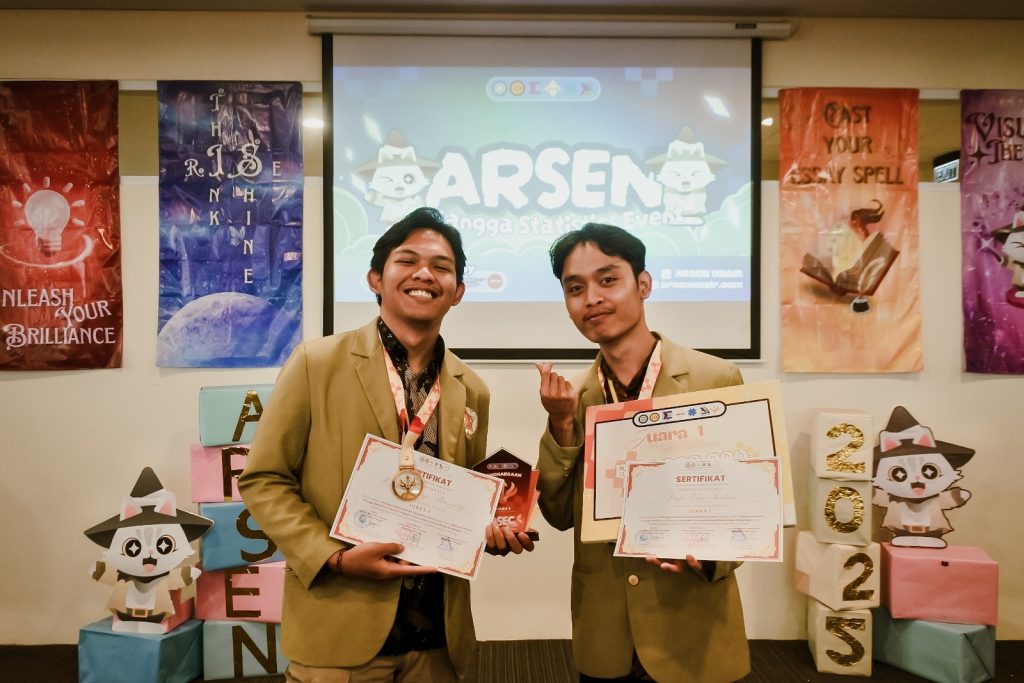
 Surabaya, November 1, 2025 – After going through a long and challenging competition process, our team succeeded in winning 1st Place in the Airlangga Statistics Essay Competition (ASEC) 2025. This victory is not only a personal achievement but also a validation of our belief that statistical science is key to solving complex urban problems.
This journey began with the main theme of the Airlangga Statistics Event (ARSEN) 2025: “Embarking on a Data-Driven Journey to Build Sustainable Communities and Equitable Cities.” ASEC, as one of the main series of events organized by HIMASTA Universitas Airlangga, carried the theme: “Aiming for Impact through Statistical Analysis to Empower Communities and Solve Urban Challenges.”
We saw a significant opportunity here. Indonesia—particularly the Jabodetabek region—frequently faces flood disasters. Our team selected the Environment sub-theme, focusing on flood mitigation solutions aligned with the urgent needs of urban development.
This idea was realized in our essay titled:
“SIPANJI: Integrasi Multi-Sensor Satellite Data dan Adaptive Artificial Intelligence untuk Prediksi, Pemantauan, dan Perencanaan Mitigasi Banjir secara Real-Time di Jabodetabek.”
(SIPANJI: Integration of Multi-Sensor Satellite Data and Adaptive Artificial Intelligence for Real-Time Flood Prediction, Monitoring, and Mitigation Planning in Jabodetabek.)
We argued that combining massive multi-sensor satellite data (big data) with adaptive artificial intelligence can produce real-time flood prediction and monitoring, transforming raw data into life-saving decisions.
The competition stages were highly rigorous. After completing Batch 1 registration (August 9–30, 2025) and Batch 2 (September 1–16, 2025), we submitted our essay during the period of September 17–21, 2025, following all requirements: using the official template, writing in proper Indonesian per PUEBI, staying within the 2,500-word limit, and ensuring that all data originated from accountable open-source platforms.
The Elimination Round (September 22–October 4, 2025) thoroughly tested the quality of our work. We understood that the largest scoring weight—40%—was allocated to Substance and Data, requiring up-to-date references and appropriate statistical methodologies presented in a structured algorithmic manner. On October 12, 2025, our team was announced as one of the seven finalists moving to the next stage.
The highlight of the competition was the Final Round on November 1, 2025, held offline at Universitas Airlangga. This was where we had to prove not only the strength of our ideas but also our scientific communication skills. The presentation and intense Q&A session—with a 45% scoring weight—tested the consistency of our arguments regarding the implementation of Adaptive Artificial Intelligence and satellite data utilization.
This victory reaffirms that SIPANJI is a viable solution and demonstrates that the younger generation can meaningfully contribute to building inclusive, just, and sustainable cities, in line with Sustainable Development Goal (SDG) 11. We extend our gratitude to ARSEN 2025 for providing this platform. This is the first step toward turning our idea from paper into real-world implementation for a more resilient future for Jabodetabek.


 Keywords: SIPANJI (AI- and Satellite-Based Flood Prediction System), Real-Time Flood Mitigation
Author: I Made Telaga Dwiraditya
Photo: Tim Anak Mba Husna