
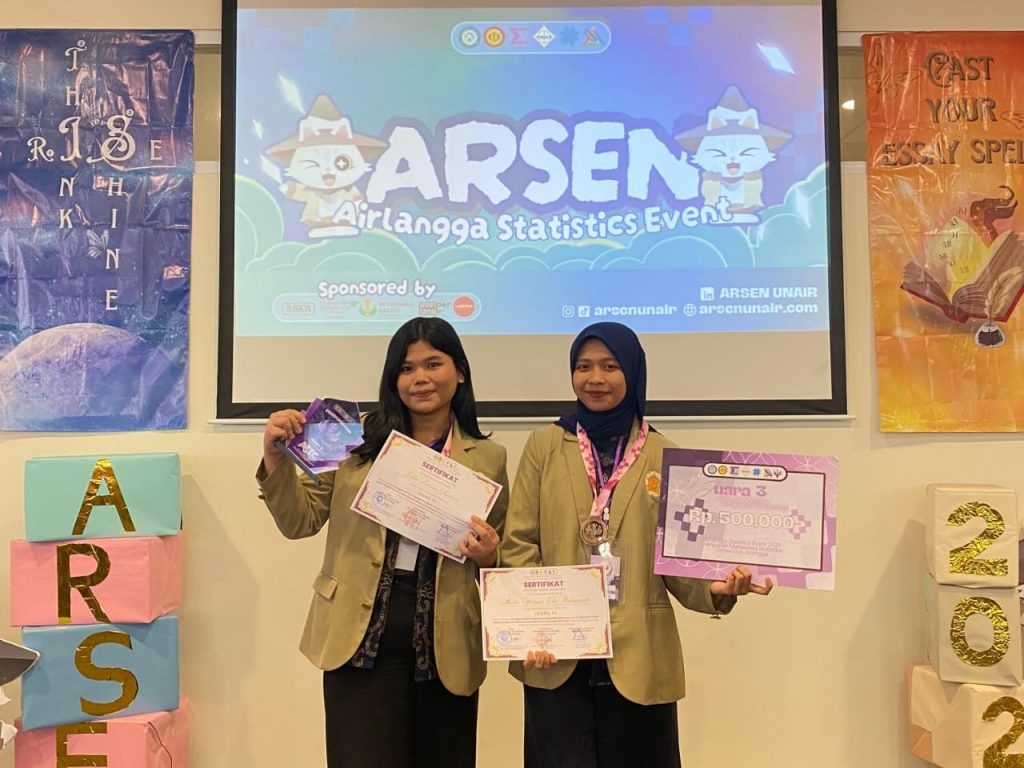
 The Airlangga Statistics Event (ARSEN) 2025 once again brought proud achievements, especially for Universitas Gadjah Mada. In the Airlangga Statistics Infographic Competition (ASIC), the Gen-Z Berkah team won 3rd Place with their innovative idea on developing earthquake-resilient cities.
ARSEN, an annual event organized by HIMASTA Universitas Airlangga, features various competition branches such as ASEC, ASIC, and ASO. This year, the Grand Final—held on Saturday, 1 November 2025 at the Gedung Kuliah Bersama (GKB) Campus C UNAIR—was filled with vibrant energy. Starting early in the morning, finalists from various universities and high schools across Indonesia gathered, totaling 42 finalists.
The event began with an opening speech from the Vice Dean I of the Faculty of Science and Technology, Prof. Mochamad Zakki Fahmi, S.Si., M.Si., Ph.D., before participants headed to their respective judging rooms. The judging process, led by lecturers of the Statistics Department UNAIR, ran intensively from 08:30 to 12:00 WIB. ASIC finalists also took part in an infographic exhibition featuring the top 15 works, which were also evaluated for the favorite winner category.
Toward midday, the atmosphere grew even livelier. A performance by Vistoric HIMASTA’s band and the musical drama “Air Raksasa dan Leluhur” by the Ritmistika arts community added excitement to the Closing Ceremony. The highlight of the event was the announcement of the winners—a moment eagerly awaited by all participants. This year, ARSEN strengthened its reputation as a prestigious statistical competition that not only challenges analytical skills but also nurtures creativity and awareness of modern development issues.
In line with the grand theme of ARSEN 2025, “Casting the Power of Data: Ignite the Path Toward Resilient Cities and Sustainable Living,” the Gen-Z Berkah team—consisting of Andin Yanuar Eka Rahmawati and Jelita Patricia Samosir, Statistics students at UGM class of 2023—presented an infographic titled:
“Building Earthquake-Resilient Cities with the SERBU Framework: Sustainable Building Framework.”
This work was driven by their concern about Indonesia’s high earthquake risk as a country situated in an active seismic zone. Gen-Z Berkah emphasized that creating earthquake-resilient cities requires strong data-driven analysis. Through risk index mapping, earthquake trend projections, and building vulnerability assessments, they designed a comprehensive solution known as the SERBU Framework.
SERBU consists of three main pillars:
- Building Checking, to assess structural conditions of buildings;
- Sustainable Building Plan, covering seismic retrofitting and base isolation;
- Residents Mitigation, focusing on community preparedness.
These three pillars complement one another, forming a model of cities that are safe, adaptive, and sustainable. The approach is not only technical but also human-centered—placing communities as an essential part of disaster mitigation.
This innovation led the Gen-Z Berkah team to become one of the top winners in the ASIC 2025 competition.
Through this work, Gen-Z Berkah hopes to encourage the public and policymakers to recognize that data plays a crucial role in designing cities that are better prepared for natural hazards. They believe that a strong understanding of risk can inspire concrete steps toward building a safer future.
“We believe that young people are not just inheritors of risk, but designers of a bright future. Building resilient cities and sustainable living is not merely a discourse—it is a real step we can begin today.”
— Gen-Z Berkah
 Keywords: Resilient Cities, SERBU Framework
Author: Andin Yanuar Eka Rahmawati
Photo: Gen-Z Berkah Team